Pros | Cons |
|---|---|
Tax advantages | Few investment choices |
High contribution limits | High fees |
Employer matching | Penalties on early withdrawals |
Shorter vesting schedules | Not always subject to ERISA |
Extra catch-up contributions |
Invest better with The Motley Fool. Get stock recommendations, portfolio guidance, and more from The Motley Fool's premium services.
Unless you're a teacher or an employee of a tax-exempt organization, you may not be familiar with the 403(b). Named after the section of the tax code that describes it, a 403(b) is a special type of retirement savings plan that's similar to a 401(k) in many ways but with a few key differences.
Here's a brief overview of 403(b) retirement plans, including their pros, cons, and contribution limits, to help you make the most of this account.
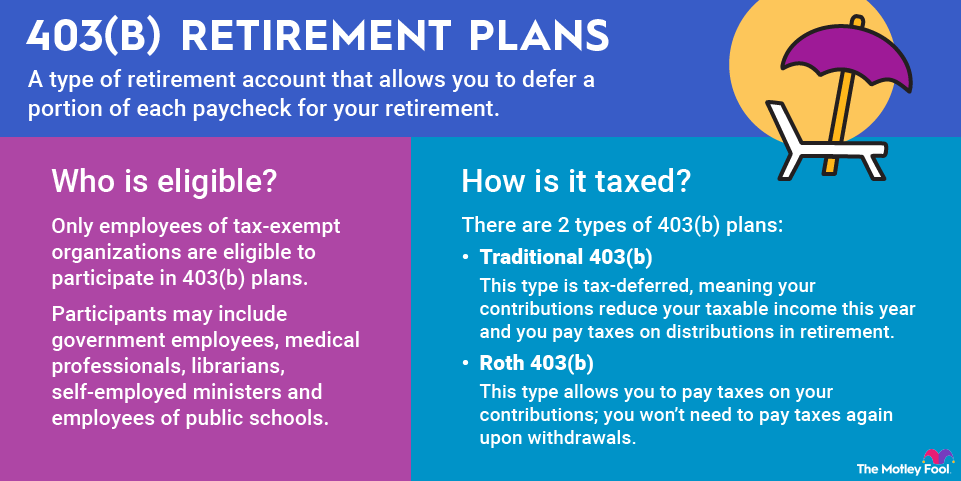
A 403(b) plan is a type of retirement account available to individuals who work in public education and employees of certain 501(c)(3) tax-exempt organizations. It’s similar to the more commonly known 401(k) account, which is more often offered by employers in the private sector.
A 403(b) is frequently used by:
Like a 401(k), a 403(b) account enables you to defer a portion of each paycheck for your retirement, and your employer may match some of your contributions if it chooses. A 403(b) may be either tax-deferred, meaning your contributions reduce your taxable income this year and you pay taxes on distributions in retirement, or a Roth 403(b), meaning you pay taxes on your contributions this year and your money grows tax-free afterward.
Here's a closer look at some of the benefits and drawbacks of a 403(b) plan:
The advantages of contributing to a 403(b) account include:
Some of the drawbacks to remember when contributing to a 403(b) account are:
In 2025, you may contribute up to $23,500. The 403(b) contribution limit increases to $24,500 in 2026.
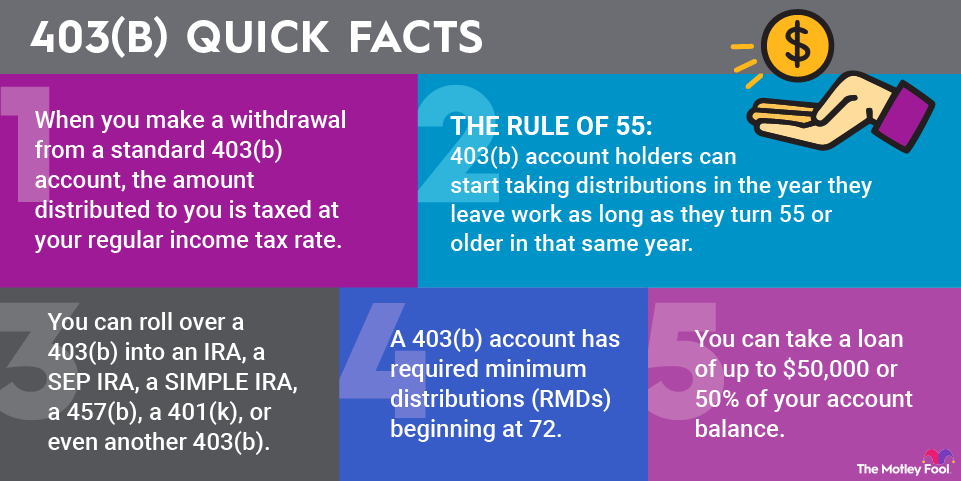
If you're 50 or older, the contribution limits rise to $31,000 (2025) and $32,500 (2026). Adults ages 60 to 63 can make an additional catch-up contribution, bringing the contribution limits to $34,750 (2025) and $35,750 (2026). These limits are the same as the contribution limits for a 401(k). Note that if your employer offers access to both a 401(k) and a 403(b) plan in the same year, the limit applies to your total contributions to both accounts.
You may be eligible to contribute up to $3,000 additional past standard contribution limits in a given year if you've worked for your employer for at least 15 years. There's a $15,000 lifetime maximum on this, so if you’re in this situation, you’ll want to keep close track of the amount of extra contributions you make.
Of course, you're not required to contribute this much annually. You may set your own savings rate and adjust it as often as necessary. Usually, you choose what percentage of each paycheck you would like to go toward your retirement, and if your company matches some of your contributions, it will also base its contribution on a percentage of your annual income.
A 403(b) can be a useful retirement savings vehicle. Stay mindful of the rules and fees to help your retirement savings grow as quickly as possible and avoid unnecessary penalties.