

As 2025 comes to a close, it's looking like it'll be a down year for major cryptocurrencies. One token that experienced a particularly dramatic reversal this year is XRP (XRP +1.50%).
Over the summer, XRP has reached a price of $3.56 -- eclipsing the $3 threshold for the first time since 2018. However, as of this writing (Dec. 18), XRP is trading roughly 48% below its intra-year high and has plummeted to a price of $1.86.
Let's explore what influenced XRP's price action throughout 2025. From there, I'll look at whether the token could be headed back to $3 in the new year.

CRYPTO: XRP
Key Data Points
It's been a volatile year for XRP
The chart illustrates XRP's price volatility this year. As investors can see, there are two notable peaks that occurred around the January and August time frames.
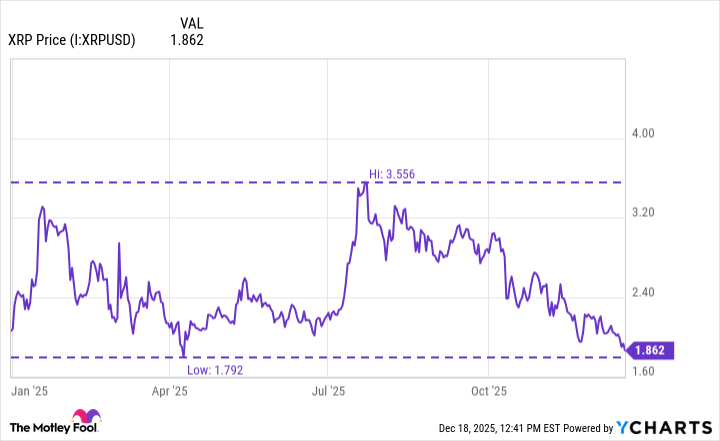
In mid-January, Donald Trump was sworn into office as President of the United States. During his time on the campaign trail, then-candidate Trump often spoke highly about his respect and interest in the cryptocurrency industry. In particular, the GOP nominee took a liking to Bitcoin.
Trump promised to usher in a new era of pro-crypto supporters and regulatory frameworks in Washington as part of his administration. This rhetoric was well-received by cryptocurrency enthusiasts -- thus, a speculative buying frenzy started to take shape.
As these trends indicate, XRP's rally following Trump's inauguration was short-lived, and the token traded sideways for several months. Over the summer, however, a new development formed and sparked a renewed sense of euphoria around XRP.
The Securities and Exchange Commission (SEC) dropped its years-long lawsuit against Ripple -- the issuer of XRP. This regulatory win, in addition to some investors anticipating interest rate reductions from the Federal Reserve were on the horizon, fueled more speculative buying activity around XRP.
While XRP briefly climbed to its highest level in nearly a decade, the token has experienced a prolonged sell-off over the last several months.
A distinction between XRP and Ripple some investors are missing
Two of the biggest hurdles in sending funds overseas are timing and cost. Specifically, when businesses transfer money to a vendor in another country, it often takes days for the transaction to settle. Moreover, intermediary banks that handle these funds each charge their own processing and foreign transaction fees.
Ripple is a financial technology company seeking to disrupt the cross-border transactions market. The company's infrastructure is able to process payments in seconds or minutes, compared to incumbent providers like the Society for Worldwide Interbank Financial Telecommunications (SWIFT) network, which often takes multiple business days. In addition, Ripple's service is often less expensive compared to traditional providers.
With all this said, there is a glaring distinction between XRP and Ripple that investors may not fully appreciate. A bank or corporation can use Ripple while still denoting their transactions in fiat currency. This option points to a broader theme, in that Ripple's success does not automatically imply accelerated adoption of the XRP token in the world of financial services.

Image source: Getty Images.
Will XRP go back to $3 in 2026?
Going into 2026, several tailwinds could potentially lead to wider adoption of cryptocurrency beyond niche use cases. In particular, a rising number of banks and large retailers are exploring the use of stablecoins, as well as other decentralized finance (DeFi) protocols.
In my eyes, these developments are more macro ideas that could potentially help Ripple in the evolving world of digital payments. That said, it's a coin toss whether XRP will be an immediate beneficiary of these trends next year.
While I am bullish on XRP for the long run, I'm struggling to identify clear catalysts that could fuel the token back to $3 or more by next year. For these reasons, I do not see XRP climbing higher in the new year.
