

With 2025 rapidly drawing to a close, this might be a good time for investors to make adjustments to their portfolios in preparation for the new year. The artificial intelligence (AI) industry has been a major source of stock market returns this year, and in fact, investors who haven't owned a slice of key players like Nvidia and Palantir Technologies probably underperformed the benchmark S&P 500 (^GSPC +0.88%) index.
But there's a simple solution for those investors as we head into 2026. The Roundhill Generative AI and Technology ETF (CHAT +3.18%) and the iShares Future AI and Tech ETF (ARTY +1.84%) are exchange-traded funds (ETFs) that invest exclusively in the booming AI sector. They take the guesswork out of picking winners and losers in the AI race, so here's why they could be great additions to any diversified portfolio for the new year.

Image source: Getty Images.
The case for the Roundhill Generative AI and Technology ETF
The Roundhill ETF exclusively invests in companies developing the infrastructure, platforms, and software behind the AI revolution. The fund is actively managed, meaning Roundhill's team of expert investors regularly adjusts its portfolio based on what they believe will produce the best returns.
The ETF currently holds just 49 stocks, and its top five positions alone account for 26.7% of the value of its entire portfolio. Although such a high degree of concentration can lead to volatility, those five stocks are among the leaders in the AI race:
|
Stock |
Roundhill ETF Portfolio Weighting |
|---|---|
|
1. Alphabet |
7.53% |
|
2. Nvidia |
6.11% |
|
3. Microsoft |
5.13% |
|
4. Meta Platforms |
4.28% |
|
5. Palantir Technologies |
3.67% |
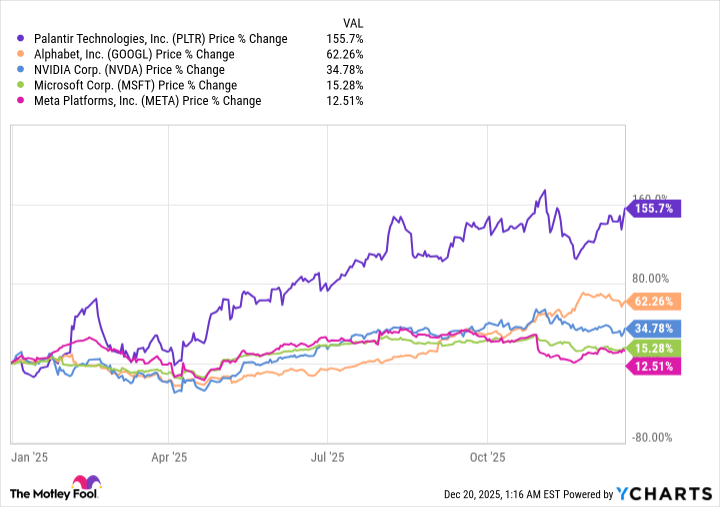
Those five stocks have delivered an average return of 55% in 2025, so they helped propel the Roundhill ETF to a year-to-date gain of 45%. For some perspective, the S&P 500 is up just 17%:
Alphabet is coming off two straight quarters of accelerating revenue growth in its Google Search business, almost entirely thanks to new AI-powered features like AI Overviews. Revenue growth in its Google Cloud segment is also accelerating, as the platform works to fill a staggering $155 billion order backlog from customers who are waiting for more of its AI data centers to come online.
Many of those data centers are powered by Nvidia's chips, which are the gold standard for developing AI models. But Alphabet isn't the only company lining up to buy them, because Microsoft and Meta Platforms are also two of the chip maker's top customers. Meta uses them to advance its open-source Llama AI models, and Microsoft uses them to deploy its Copilot AI assistant, and it also sells computing capacity to businesses through its Azure cloud platform.
Actively managed funds typically come with high costs. The Roundhill ETF has an expense ratio of 0.75%, whereas many of the passive index funds issued by Vanguard, for example, offer expense ratios of as low as 0.03%. Fortunately, investors have been well compensated for those costs so far thanks to the Roundhill ETF's blistering returns since its inception in 2023.

NYSEMKT: CHAT
Key Data Points
The case for the iShares Future AI and Tech ETF
The iShares ETF invests in AI companies from the U.S. and around the world. It gives investors exposure to the entire AI value chain including infrastructure, software, and services. The ETF holds 51 stocks, and below are its top five positions which represent 23% of the value of its portfolio:
|
Stock |
iShares ETF Portfolio Weighting |
|---|---|
|
1. Advanced Micro Devices |
5.48% |
|
2. Vertiv Holdings |
5.25% |
|
3. Nvidia |
4.28% |
|
4. Advantest Corp |
4.06% |
|
5. Broadcom |
3.96% |
Despite having a similar focus to the Roundhill ETF, the composition of the top five holdings in the iShares ETF is quite different. It places a heavier emphasis on suppliers of data center infrastructure and chips, which have been central to the AI boom over the last few years.
Advanced Micro Devices is one of Nvidia's biggest competitors in the market for AI data center chips. The company is preparing to launch a new lineup of graphics processing units (GPUs) in 2026 called the MI400 series, which could lead the industry in terms of performance.
Broadcom is another major player in this space. It supplies an alternative to GPUs called AI accelerators, which are popular among hyperscale customers because they are fully customizable. Broadcom is also a top supplier of networking equipment, which helps regulate how fast data travels between chips and devices in AI workloads.
Then there is Vertiv, which is a critical service provider for data center operators. It offers cooling, power management, and networking solutions, and its stock has soared more than tenfold since the AI boom started gathering momentum in early 2023.

NYSEMKT: ARTY
Key Data Points
The iShares ETF has an expense ratio of 0.47%, but with a return of 28% this year, it's crushing the S&P 500 even after accounting for fees. AI is likely to remain a key driver of stock market returns in 2026, and investors can get all the exposure they need to this booming industry by adding the iShares and Roundhill ETFs to their diversified portfolios.
