


United States’ biggest jet manufacturer Boeing (BA 0.18%) recently raised its outlook for India. The current outlook suggests that India could order 1,740 jets over the coming 20 years, 8.75% more than the previous forecast. Boeing’s upbeat expectation rests on the country’s enormous growth prospects, improving GDP, and expansions by leading airlines. Let’s try and gauge how much the country can add to Boeing’s coffers.

Image source: Boeing.
Indian airlines faring better, traffic going up
Historically, air turbine fuel has formed almost 50% of Indian airlines’ costs and kept most of them in the red. But the oil price dip that started from June last year changed the scenario to some extent. In fiscal year ended March 31, 2015, Indian airlines’ trimmed their losses by 30%, according to CAPA.
Airlines SpiceJet and Jet Airways, important Boeing customers, posted profit in their last two quarters after a series of losses. With more money in their hands, carriers are in a position to go plane-shopping to cater to the rising air traffic.
Domestic air traffic growth in the country is at a five-year high of 19.4% between January and June 2015, which is higher than even China (12.3%) for the same period, placing India ahead of the top seven domestic airline markets in the world. Indian airlines flew 45 million passengers in those six months, 21% more than compared with 37.6 million in the year-ago period.
Dinesh Keskar, who looks after Boeing’s commercial plane sales in Asia-Pacific and India, sees 75 million passengers flying in 2015-16.
A strong economy bodes well
A reviving Indian economy is being seen as a big reason behind the growth. The GDP expanded 7% in the April-June quarter. Boeing in its global market outlook expects India to have an above average GDP growth. India’s GDP is expected to grow at a compounded annual growth rate of 7.8% in the next decade, surpassing the global growth of 3.3%.
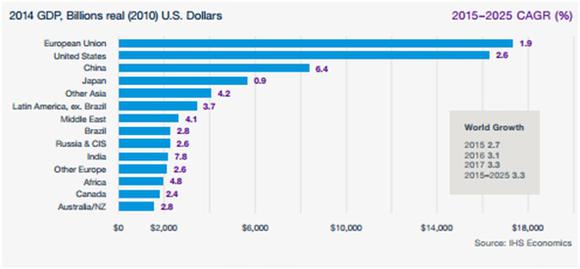
Image source: Boeing Current Market Outlook
Boeing’s position
Boeing has had its base in India for over 70 years. Of the 411 airplanes in operation in India, Boeing holds a 39% (160 in operation) share, wherein 69% or 111 are narrow-body 737s, and 31% or 49 are widebodies (777, 747, 787).
Though Boeing is behind rival Airbus in the narrow-body battle as the European plane maker has 191 single-aisle A320s flying in the Indian skies, Boeing is ahead in the wide-body race as Airbus has just 12 A330s in operation. India has two full-service carriers – Air India and Jet Airways – and both have an inclination towards Boeing’s widebodies.
Air India’s widebody fleet has 43 aircraft, out of which 41 are from Boeing’s stable. In fact, Air India is the first and, till now, the only Indian airline to become a 787 customer, owning 21 of the Dreamliners. Out of Jet Airways’ fleet of 115 jets, 85 are of Boeing’s.
Jet Airways is nicely capitalising on the rising international traffic to and from India, which grew 9% in 2014-15. The airline carried around 75% of the increased international traffic in the period and has left the once indomitable Emirates behind. CAPA says the Indian full-service carrier is “clearly prioritising growth on international routes following its partnership with Etihad.” This could bring more business Boeing’s way.
Favorable developments
There are two other reasons that could spur Boeing’s widebody sales: firstly, new airlines, such as full-service carrier Vistara and low-cost carrier AirAsia India, entering the Indian aviation scene will push demand for new planes. These two have started off with Airbus, but once they are ready to fly overseas, Boeing’s 787s and 777s might be hard to resist.
Secondly, the Indian government might relax rules for new airlines to fly overseas. Currently an airline needs to fly five years domestically and have 20 planes to be eligible for flying abroad. Once the rules change, there will be more airlines shopping for wide-bodies, where Boeing seems to have a clear preference.
A $112-billion opportunity
If we apply Boeing’s present Indian market share to the 20-year forecast of 1,740 jets, and do a conservative estimate, it’s a $112 billion opportunity. Airbus clearly dominates the Indian narrow-body market, but the lucrative wide-body arena is Boeing’s to play. The American aero major will do all it can to maintain and further the hold of its 777s and 787s.
